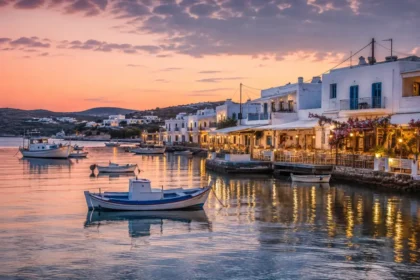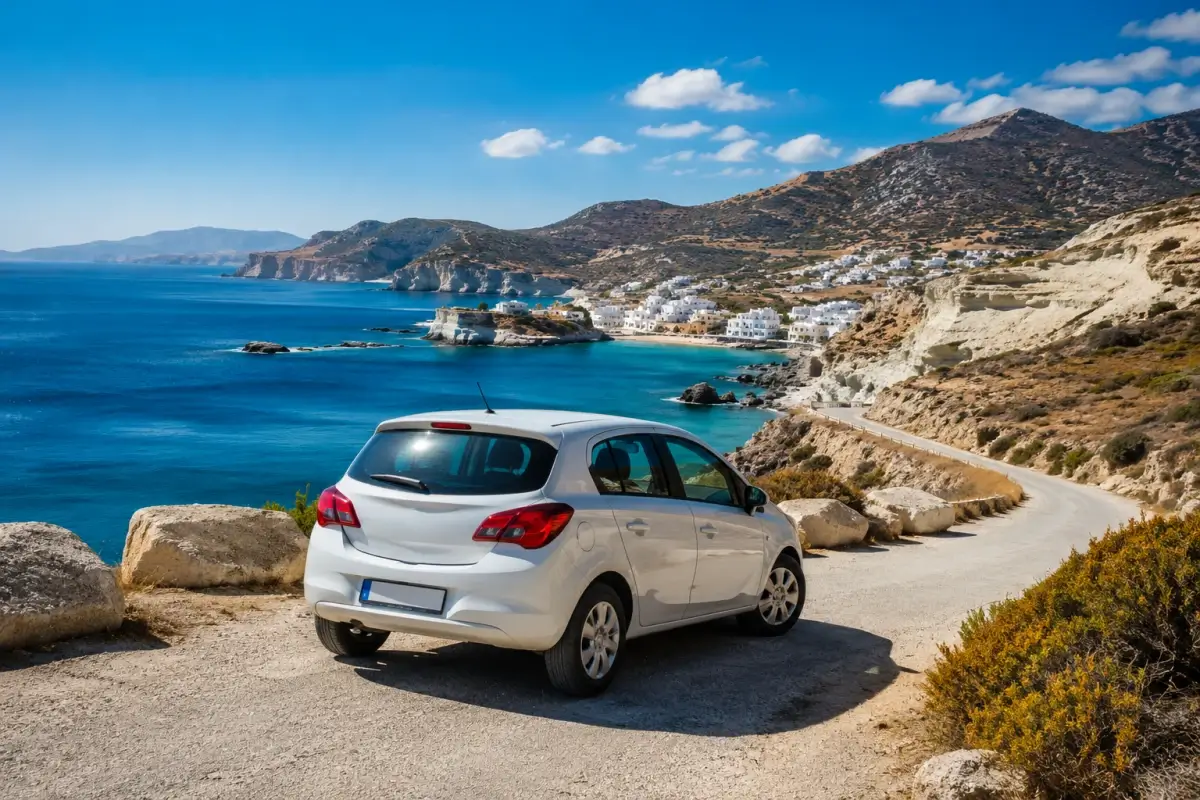
Milos rewards travelers who have control over their transport. Beaches, fishing villages, and sunset stops are scattered across terrain the bus network only partly serves. For most short stays focused on seeing the island, a small rental car is the strongest choice. A car-free trip can work, but it needs a tighter plan: stay near Adamantas, use the bus where it is useful, arrange arrival and evening rides in advance, and add one well-chosen tour.
ATVs and scooters are common alternatives for confident riders, but they are not the default recommendation. Roads can be narrow, steep, dusty, or unpaved, and wind exposure matters on longer rides.
Rent a car for beach-hopping; stay car-free for a tighter village-and-tour plan
For a first trip to Milos, we would rent a small car if the plan includes more than one beach, the fishing villages, Sarakiniko early in the day, or Plaka after dark. Walking between bases is not practical here, and the island’s best days often involve several stops rather than a single destination reached by one bus.
A car is less about distance than control of the day. It allows for an early start at Sarakiniko, beaches paired with Mandrakia or Klima, and a return from Plaka without planning the evening around a bus departure. It also makes stays outside the main towns substantially easier.
Car-free travel suits travelers who want to contain the logistics. Base in Adamantas, where the bus network and many boat departures are centered, then focus on Plaka, Pollonia, Sarakiniko, and beaches served by the current timetable. Add a group island tour or boat excursion instead of trying to reproduce a self-drive circuit with taxis.
Taxis are the weaker substitute for a rental vehicle. They can solve individual journeys, but limited supply and repeated fares make them an uncertain framework for a beach-led trip.
Arrive at the airport or Adamantas port with the first transfer arranged
Milos has two main arrival points: Milos Airport and the port at Adamantas. Before landing or disembarking, decide whether a rental vehicle or arranged transfer will be waiting.
Depending on the provider, rental cars, scooters, and ATVs can be collected at the airport or port. This is the cleanest arrangement for anyone renting, particularly in summer, when vehicle supply can tighten. Confirm the pickup point, return procedure, and whether the vehicle is permitted on the roads planned for the trip.
Without a rental, arrange a private transfer or taxi in advance through the accommodation or a local booking channel. Taxi supply on Milos can be limited, particularly in high season, so a pre-arranged ride also keeps a luggage transfer from becoming the stay’s first scheduling problem.
Adamantas is the practical car-free base: it is the port town, the center of the public bus network, and a departure point for coastal excursions. Plaka works for travelers who prioritize the historic village and are comfortable organizing rides around it. Pollonia is a quieter seaside base, but it is less forgiving without a vehicle if the trip extends beyond the village itself.
Things to know: Arrange the arrival leg before reaching Milos. A rental pickup or pre-booked transfer is more dependable than assuming a taxi will be available at the airport or port.
A rental car is worth it when the island itself is the itinerary
Rent a car for the full stay if beaches and villages are the reason for coming to Milos. The island’s appeal lies in moving among distinct landscapes: Sarakiniko’s pale rock formations, south-coast beaches, hillside Plaka, and the fishing settlements of Klima, Mandrakia, and Firopotamos. Public transport reaches part of that picture. A car makes the rest realistic.
Keep it small. Roads can be narrow, parking can become tight at popular beaches, and rough or unpaved stretches exist in parts of the island. A compact vehicle is easier to manage than a larger one, while suitable clearance may matter on roads the rental company permits.
Private transport also changes the timing of a Milos day. Sarakiniko is served by bus, but an early visit is easier by car. The same applies to Plaka, where walking the village and climbing toward the castle are easier without having to organize the return around public transport. Travelers hoping to photograph, swim, and move on at their own pace will feel the difference immediately.
There are limits. Some rental companies restrict the unpaved roads their vehicles may use, and a low-clearance car may not suit every route. Do not assume a vehicle advertised for Milos can be driven everywhere on the island. Before booking, ask about permitted roads, insurance, roadside assistance, and the provider’s policy on damage sustained off paved routes.
Parking is another argument for a compact car. Sarakiniko and other popular sites can draw crowds, particularly in summer. A rental removes dependence on the bus, but not the need to arrive early or accept a short walk from available parking.
For families, travelers carrying beach equipment, or anyone staying in a fishing village or other remote accommodation, a car becomes considerably more useful. Some traditional coastal stays have uneven approaches, and supplies or luggage are easier to manage with private transport.
Choose an ATV or scooter only if the riding conditions suit you
ATVs, quad bikes, and scooters can suit travelers already comfortable riding them. They take up less room, are easier to park, and can make a short beach-hopping day feel less cumbersome than driving a car, especially around busy beaches and narrow village roads.
They suit confident riders traveling light better than families, long road days, or anyone without prior riding experience. Milos can be windy, and certain roads are steep, dusty, or rough. Those conditions matter more on an exposed vehicle, particularly after dark or on routes far from the main towns.
Licensing requirements vary by vehicle type, rental company, and the license held by the traveler. Depending on nationality and vehicle category, additional documentation may also be required.
Confirm the required license before reserving, not at the counter. Ask about helmets, insurance, fuel policy, road restrictions, and whether the vehicle is intended for unpaved roads. The fun factor is real, but not a reason to compromise on experience or road conditions.
Our view is simple: choose an ATV or scooter because it suits existing riding ability and a limited route plan. Choose a car when comfort, weather protection, luggage capacity, and flexibility matter more.
Use the Adamantas bus for main towns and selected beaches, not total freedom
The public bus works best when the trip is designed around it. The network is centered on Adamantas, with routes connecting main areas including Plaka and Pollonia, along with selected beaches such as Sarakiniko, Fyriplaka, Paliochori, and Papafragas.
For a short, lower-complexity stay, this can be enough. From Adamantas, the bus can support a day in Plaka, a visit to Pollonia, or a beach day at a stop running during the relevant period. It is also a better use of time than repeatedly hiring taxis for predictable daytime journeys.
The timetable determines the day. Service varies by month and season, and evening coverage can be less useful than daytime connections. Check departure times for the actual travel dates rather than relying on schedules quoted elsewhere.
Do not build a multi-stop day around public transport unless the current timetable leaves room for a missed departure or a longer-than-expected beach stop. The bus is strongest for one principal destination at a time. It is weaker for very early starts, late dinners away from the base, remote south-coast exploration, or days combining several fishing villages.
Check the current Milos bus timetable before booking accommodation and again shortly before travel. For a car-free stay, the last useful connection of the day often matters more than the first.
Treat taxis as a pre-booked backup, not your island-wide transport plan
Taxis exist on Milos, but they are not the transport system we would build a beach-led holiday around. Supply can be limited, particularly in summer, and repeated journeys quickly make a rental car more compelling. A taxi is better used for an airport pickup, port transfer, or dinner return.
A private transfer is arranged in advance for a specific journey; a taxi may be sought closer to the time of travel. Both can be useful, but neither should be assumed immediately available at the airport, port, a beach, or after dinner.
For a car-free trip, arrange arrival transport before reaching the island and pre-book any evening ride with a fixed deadline. Accommodation hosts may also be able to help coordinate local transport. Availability can still change, particularly in summer, so do not leave a remote return leg to chance.
Use walking in villages and a boat tour for the coastline vehicles cannot reach
Walking belongs within the villages, not between them. Plaka’s narrow streets are made for exploring on foot, and the historic area around Trypiti, including the ancient theater and catacombs, can form a walk once transport has delivered travelers there. Klima can also be explored on foot, although reaching it is more complicated without a vehicle.
Walking is not a realistic substitute for land transport between Adamantas, Plaka, Pollonia, and the island’s main beaches. Milos is hilly in parts, and the central bases are too far apart for a casual inter-village walk, particularly in summer heat or with beach gear.
A boat excursion solves a different access problem. Trips departing from Adamantas can reach Kleftiko, sea caves, and sections of coastline that cannot be reached by road. This is an activity day, not a ferry-like way to move between accommodation areas.
Leave flexibility around a Kleftiko outing. Wind can affect whether boats operate or which parts of the coast they can reach. Travelers making a boat day the centerpiece of a short car-free visit should keep another day available if weather forces a change.
The practical Milos plan: combine one reliable base with the right transport days
For a beach-led Milos stay, rent a small car for the full trip and keep one base. Adamantas is the most practical all-around choice, though Pollonia, Plaka, or a fishing village can work well once a car removes the transport constraint. Use it for beach days, villages, early starts, and evenings, then reserve one boat excursion for Kleftiko and the road-inaccessible coast.
For a short car-free stay, base near Adamantas. Take the bus only on routes that fit the current timetable, pre-arrange the airport or port transfer, and book any evening taxi before heading out. One island tour can replace the most awkward self-guided land day; one boat trip covers coastal sights no car can reach.
A mixed plan can suit travelers who do not want to drive every day. Rent a car for beach and village days, then return it before a boat day or final evening in Adamantas. This works only if pickup and return timing is confirmed with the rental company and the accommodation does not depend on the car after its return.
The decision is straightforward. Rent a car if the island itself is the itinerary. Stay car-free only if the trip is intentionally narrower, centered on Adamantas, and built around bus departures, arranged rides, and one or two structured excursions. For guidance on choosing a base around that decision, see where to stay in Milos.