Rhodes merits more than a resort holiday. Its strongest experiences bring medieval streets, classical ruins, whitewashed Lindos, and the east-coast sea into proportion. For first-time visitors with roughly three to seven days, prioritize Rhodes Old Town, Lindos, one proper swim day, one boat experience, and either an ancient site or an inland drive.
July and August can bring serious heat, with Lindos among the island’s hottest places, along with heavier visitor pressure at the headline sights. The answer is not a longer list. Choose fewer outings that still feel good in the middle of the day. For broader planning, see our Rhodes guide.
Our selections weigh cultural substance, setting, physical effort, and the practical compromises that shape the day. Read more about how we evaluate destinations and experiences.
Wander Rhodes Old Town for the island’s medieval core
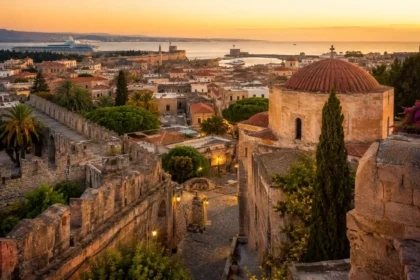
Rhodes Old Town is the essential starting point: not a single landmark, but a functioning medieval city of gates, cobbled lanes, squares, former inns, mosques, museums, and defensive stonework. Allow at least half a day, and longer if the museum collection matters as much as the streets. The Medieval City is a UNESCO World Heritage Site, and its accumulated Byzantine, Knights of St. John, Ottoman, and Italian histories are visible without forcing a formal route.
Begin at the Palace of the Grand Master, a fortress that became the Knights’ headquarters and later served Italian rulers. The Street of the Knights runs downhill through the order’s former lodgings. The Archaeological Museum occupies the former Hospital of the Knights and holds material from Rhodes’s classical past. Finish at Mandraki Harbor, just beyond the walls, where the town’s maritime side comes into view alongside the windmills and Fort of St. Nicholas.
Walk independently if atmosphere and the freedom to turn into quieter lanes matter most. A guide is worthwhile for travelers who want the layers of rule and rebuilding made legible. Cobblestones, heat, and cruise-day traffic can make the center demanding, so early morning and evening are better for unhurried wandering. The Street of the Knights, in particular, is best outside the central daytime rush.
Things to know: Old Town is pedestrianized in parts, and its cobbled surfaces are not ideal for rolling luggage or flimsy sandals. Treat the Palace, Street of the Knights, Archaeological Museum, and harbor as one area, not separate excursions.
Give Lindos a full visit, but reach the Acropolis before the heat
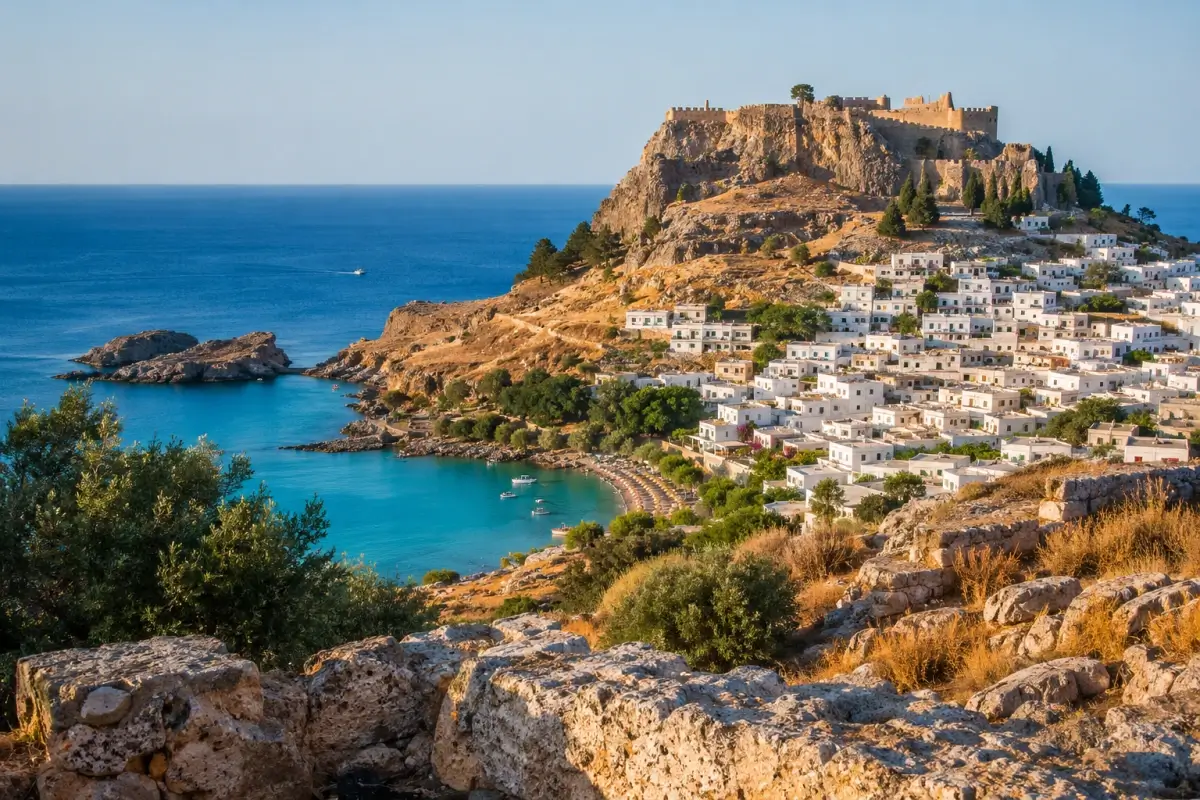
Lindos is the island’s one nonnegotiable trip beyond Rhodes Town. The argument is unusually complete: a whitewashed village below an Acropolis, the Temple of Athena Lindia on the hilltop, and swimmable bays within reach. It deserves a full visit, not a hurried photo stop, but timing matters more here than anywhere else.
The climb to the Acropolis is steep and exposed, with stairs, rocks, and surfaces that can be slippery. Grippy footwear and water are practical requirements, not over-preparation. Aim for opening time where current access permits, or go later in the afternoon. In July, midday can combine intense heat with heavier visitor pressure, so it is a poor window for the climb.
Independent travel gives Lindos the time it needs: the Acropolis first, then the village lanes, followed by a swim if heat and energy allow. A car gives the greatest control. Public buses, shuttle transfers, and boat trips remove the navigation burden but may compress time on the ground. There is no need to cover every nearby bay after the climb. Choose Lindos Beach for the easy pairing, or walk to St. Paul’s Bay if its setting is the stronger draw.
Choose one east-coast swim day
Rhodes has enough coastline to make beach collecting a poor use of a holiday. The east coast is generally calmer than the west, while the west can have higher waves and less-clear water when sand is stirred up. Pick one beach day for the kind of swimming you want, and leave the rest alone.
Anthony Quinn Bay suits a compact, scenic swim and snorkeling stop. It sits by Ladiko, where two small bays are divided by a promontory, and clear water is the main appeal. Its limitation is simple: a smaller cove has less room to absorb visitors. Think of it as a focused swim, not an all-day stretch of sand.
For a longer, simpler beach day, Tsambika Beach is stronger. Its broad golden sand shifts the experience from cove-hunting to settling in, though the visual drama is less concentrated than at Anthony Quinn Bay. Kallithea Springs works for travelers who want swimming attached to a named coastal stop rather than an entirely beach-centered day. Facilities, access, and sea conditions vary by season and site, so confirm the current setup before committing.
Without a car, a short swimming or snorkeling cruise can replace the road logistics of reaching several coastal stops. It is the right compromise for visitors who care more about time in the water than ticking off beach names.
See Rhodes from the water on a well-chosen boat day
A coastal boat day earns its place when swimming, snorkeling, and time in the bays are the focus, not a loud all-day format that turns the sea into background entertainment. Rhodes Town and nearby resorts have many departures, from short snorkeling trips to longer cruises with meal and drink inclusions. Format matters more than the largest package.
We would favor a smaller swimming or snorkeling cruise where available, especially one with modest capacity and clear stops. Some routes link Anthony Quinn Bay and Kallithea Springs, while longer cruises may add Afandou. A shorter boat trip can be enough if beach time is already planned. A fuller day makes more sense when the boat is the principal water experience.
Do not confuse a local coastal cruise with a trip to Symi. Symi is a separate full-day commitment, with travel time and time ashore changing the character of the day. Before booking, check the operator’s current departure point, route, capacity, food and equipment inclusions, cancellation terms, and weather policy. Sea conditions can change the plan, and it is unwise to place a fixed reservation immediately before an onward flight or inflexible transfer.
See ancient Rhodes from Monte Smith before adding another ruin
Monte Smith is the efficient answer for travelers who want classical Rhodes without giving a full day to an island excursion. The Acropolis of Rhodes sits on the hill southwest of Old Town and preserves the Temple of Apollo alongside the stadium and Odeon. It provides a useful contrast to the Knights’ city, bringing Rhodes’s ancient past into focus without leaving the town area.
It does not substitute for Lindos, whose Acropolis, village, and beaches make for a much bigger outing. Monte Smith works best for a spare morning or late afternoon when classical history is the priority and transport is not. Add it to a Rhodes Town stay only if the cumulative heat and walking are manageable. Do not stack it onto a museum-heavy Old Town day.
Access arrangements and opening conditions for archaeological areas can change. Verify them before going, particularly in warmer months, when exposed sites are least forgiving.
Visit Ancient Kamiros for a quieter archaeological counterpoint to Lindos
Ancient Kamiros, also spelled Kameiros, suits visitors who want to read a site at their own pace instead of moving through Lindos’s village-and-Acropolis combination. It is one of the island’s established archaeological stops, but its west-coast location makes it an excursion, not a quick add-on from Rhodes Town.
A rental-car loop or an archaeological tour with genuinely useful scope is the strongest format. Pairing Kamiros with unrelated stops simply to fill a day can make the ruins feel incidental. A car gives more control over time at the site; a properly planned tour removes the need to manage roads and navigation.
Expect exposure rather than shade, and bring water. Confirm current access before setting out. Kamiros is a good second archaeological choice for travelers who have already given Lindos its due, not a reason to reduce time there.
Walk Butterfly Valley only when its seasonal nature is the point
Butterfly Valley, or Petaloudes, is a conditional recommendation. During summer, Jersey tiger moths gather in the valley, where cypress and plane trees, wooden bridges, waterfalls, and walking trails create a markedly more shaded setting than the island’s exposed ruins and beaches. For visitors arriving in the hotter part of the season, that contrast is the reason to go.
It should not be presented as a guaranteed wildlife display. The moth gathering is seasonal, and this is fundamentally a nature walk, not a substitute for Lindos or Rhodes Old Town. Go if a quieter inland walk appeals and the seasonal context aligns. Skip it if the schedule already struggles to fit the island’s core historical and coastal experiences.
Pair Butterfly Valley with other inland stops only when transport and current opening conditions make the combination sensible. Do not make it a rushed detour between distant coasts.
Cross the island by car or small-group tour for castles, villages, and wine
Rhodes becomes more interesting once the route leaves the resort coast, but the island is large enough that an inland circuit needs a full day. Kritinia Castle, mountain scenery, and the Embonas area’s wine and honey tastings make a coherent alternative to another beach day. This works best for travelers with extra time, or those who would rather not piece together inland transport.
A guided island tour brings context at Kritinia and removes the need to navigate between dispersed stops. It can include wine, olive oil, or honey tastings, though inclusions differ by operator. Self-driving gives travelers control over time at the castle or in a village, but requires confidence on local roads.
This is a long, multi-stop day. Let it replace an ambitious morning of ruins, not follow one. Check the current itinerary before booking, as a tour advertised as an island round trip may emphasize different stops, tastings, or pickup areas.
What to skip
Walking the full Old Town walls: If time is tight, the payoff is modest compared with the Palace, Street of the Knights, Archaeological Museum, gates, and harbor. Keep the walls as part of the city’s setting instead of making their full circuit an objective.
A generic all-day boat party: It can trade space, flexibility, and coastal focus for a format with little to do with why Rhodes’s water is worth seeing. Choose a smaller swimming or snorkeling cruise instead.
Every famous beach: Anthony Quinn Bay, Tsambika, Kallithea Springs, Lindos Beach, and others can all be defensible choices. Trying to cover them all creates travel time without improving the holiday. Choose one coast and one purpose: snorkeling, a broad beach day, or swimming attached to a cultural stop.