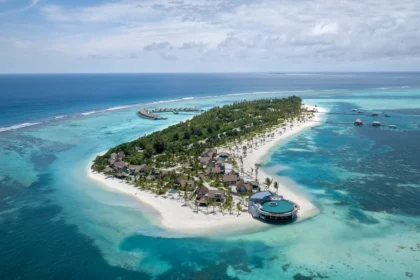
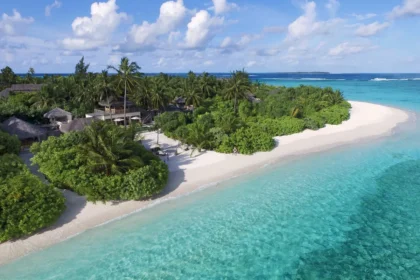
The Maldives is not a single beach destination with interchangeable hotels. The central decision is whether to stay on a private resort island, where dining, beaches, and facilities sit within one managed setting, or on a local island, where guesthouses cost less and everyday Maldivian life is closer at hand. After that comes the practical calculation: how much time, money, and transfer complexity are worth exchanging for a more remote atoll?
For most first visits, we would choose a private resort island in North Malé Atoll over the longest possible seaplane journey. For travelers constrained by budget, Maafushi is the more useful answer. The villa matters, but the island comes first.
Start with the island decision: resort privacy or local-island value
A private resort island is the classic Maldives proposition: accommodation, restaurants, bars, watersports, and beaches gathered on one island. Alcohol is available within the resort setting. It suits travelers who want a self-contained holiday, whether for a short romantic break, a family stay with organized activities, or several days focused on the beach and reef.
Local islands alter both the price and the texture of the stay. Guesthouses and smaller hotels can make the Maldives more attainable, while local streets, cafés, and excursion operators create a less insulated experience. Cultural rules apply: swimwear is generally limited to designated tourist beaches, and alcohol is not sold outside private resorts and liveaboards. This is not a cheaper version of a resort holiday. It is a different trip, with less privacy and more need to plan transfers and beach time.
Room choice comes second, though it can be expensive. Overwater villas are usually the costliest category, especially those with private pools. They may sit farther from restaurants and other facilities, and some resorts restrict them for families with small children. Beach villas are often the stronger fit for travelers who want shade, direct sand access, more privacy from neighboring decks, and a shorter walk to the resort center. A ladder into the lagoon is compelling, but not automatically practical.
We weigh island character, transfer burden, accommodation choice, traveler fit, and the downside that could change the decision. Read more about how we evaluate destinations and stays.
Malé: the practical overnight before an early flight
Malé is a transit base, not the main beach stay. It makes sense when a late arrival or early departure makes a same-day resort transfer impractical, or when repeat visitors want a brief look at the capital between islands. Restaurants and shops provide a short view of daily life beyond resort gates.
The compromise is clear. This compact, dense urban island does not deliver the resort-style beach experience most travelers associate with the Maldives. First-timers who have crossed an ocean for a private-island stay should not use Malé as their primary base.
Hotel Octave is the functional central option, within reach of restaurants and shops. Samann Grand is the more polished pointer, with a roof terrace and restaurant near the Hulhumalé ferry terminal. Both suit a night before or after a flight, not a substitute for a resort island. See the best hotels in Malé for a deeper city shortlist.
Maafushi: the strongest local-island base for a lower-cost Maldives
For travelers who want to direct more of their budget toward diving, snorkeling trips, and day excursions, Maafushi is the clearest alternative to a private resort island. This popular local island near Malé has guesthouses, smaller hotels, water activities, and an accommodation market fundamentally different from the resort model.
An older 2020 guide recorded stays from roughly $40 to $100 per night, but that should not be treated as a current price benchmark. Rates, boat schedules, and transfer costs move. The useful distinction is structural: local-island accommodation is generally the lower-cost route into the Maldives, even once excursions are added.
Maafushi works for independent-minded travelers, divers, and visitors who would rather spend on time in the water than on an overwater villa. It is less convincing for a honeymoon centered on seclusion, private dining, and uninterrupted resort space. Its popularity also means it is not the quiet escape some travelers imagine when they hear “local island.”
Plan around local norms, not as if the island were a resort extension. Alcohol is unavailable outside resorts and liveaboards, and tourist swimwear is for designated beach areas. Dhiffushi may be worth considering as a potentially quieter local-island alternative, but check transfer logistics and current accommodation options before committing.
North Malé Atoll: the best first-timer compromise between access and resort life
We would put most first-timers, short-stay couples, and families in North Malé Atoll, especially those who do not want a remote transfer to consume part of a limited holiday. Several resort islands are reached by speedboat from Velana International Airport. Published examples span roughly 10 to 45 minutes, but the exact journey, departure timing, and price are property-specific and should be confirmed directly with the resort.
Landing does not have to lead to a long wait for a daytime seaplane. On a three- or four-night stay, that can leave more time for the island itself. The cost of convenience is proximity to Malé, which can mean less of the isolated, far-from-everything feeling associated with more distant atolls.
Kurumba is the practical pick for minimal transfer time, with a stated 10-minute speedboat ride from the airport and broad resort facilities. Four Seasons Kuda Huraa is the higher-end option for families, serious dining, and spa time, with watersports and marine programming close to Malé. Velassaru suits travelers seeking a relaxed resort stay without a long onward journey, reached by speedboat in about 25 minutes.
For couples, North Malé works best when convenience matters as much as romance. Travelers who define privacy by distance from the capital should look elsewhere. Compare more properties in the best Maldives resorts, or see the honeymoon resort guide for a couple-focused shortlist.
Ari Atoll: the stronger base for reefs, diving, and the full villa fantasy
North and South Ari are best treated as one accommodation decision. Choose this part of the Maldives when reef time, diving, and villa-led resort life matter more than the fastest possible transfer. It has some of the most persuasive resort options for travelers planning to spend much of the stay snorkeling, diving, or moving between beach and water.
Reef quality is not uniform across an atoll. A resort’s house reef is a property-specific advantage, not an atoll-wide guarantee. Check whether snorkeling is available directly from the island, whether conditions suit the season, and whether the reef is reached from the beach or by boat.
Kandolhu is the intimate, food-focused option, with 30 villas across beach and water categories and five restaurants. It is reached by seaplane in about 25 minutes from Malé. W Maldives, on Fesdu Island in North Ari, is the livelier luxury pointer, with a documented house reef and a more design-led social character. LUX* South Ari Atoll is the family-oriented resort to consider, recognized by Condé Nast Traveler for families.
Choosing Ari carries a logistical cost as well as a financial one. Resorts may require a seaplane or domestic-flight connection, and seaplanes operate in daylight. A delayed international arrival can turn the first night into an airport-area stay. North Malé may make better use of time on a short trip; for a longer stay centered on the water, Ari earns the extra effort. See the guide to Maldives water villas for the room-level decision.
Baa Atoll: the choice for marine life, wellness, and high-end seclusion
Baa Atoll suits travelers prepared to pay more, transfer farther, and spend more of the holiday within one high-end resort. Its defining draw is Hanifaru Bay, known for manta activity when rays gather to feed. Encounters are seasonal and access is regulated, so treat this as a possibility to plan around, not a sighting to assume.
Four Seasons Landaa Giraavaru is the strongest wellness-led pointer, with its AyurMa center and access to Hanifaru Bay through the resort’s manta program. Anantara Kihavah Maldives Villas is the couples’ choice, an all-villa private-island stay in Baa Atoll. Together, they illustrate the area’s character: polished, resort-contained, and designed for travelers who want marine life, spa time, and privacy to be central rather than incidental.
This is not the place for travelers seeking local cafés, independent dining, or a low-cost Maldives. Seaplane access and higher overall spending come with the territory. Alila Kothaifaru is sometimes included in a similar luxury conversation, but it is in Raa Atoll, not Baa Atoll, and should not drive a Baa-based decision.
Budget, transfer, and meal-plan reality before you book
The room rate is only part of the Maldives total. Resort transfers are commonly charged separately, and a remote resort can add a significant amount before meals, drinks, diving, and spa time enter the calculation. Seaplanes appeal to some travelers, but their daylight schedules make flight timing consequential.
Local-island stays are generally the lower-cost option. Private-island resorts run from relatively accessible choices near Malé to ultra-luxury properties, with rates varying materially by season. Expedia’s 2026 traveler data identifies June and August through September as relatively lower-priced hotel periods compared with December through February, though an individual resort’s pricing can differ sharply.
All-inclusive can make sense on an isolated resort island, where every meal and drink comes from the same limited collection of venues. It is less compelling when inclusions are narrow, when the dining program matters enough to justify paying separately, or when the traveler plans regular excursions. Half board can work for those who want breakfast and dinner settled. Room-only makes the most sense on local islands with independent dining nearby.
Before booking, compare the full figure: room, taxes, mandatory transfer, meal plan, and the activities that are actually part of the trip. For seasonal trade-offs, read the best time to visit the Maldives.
The short answer by traveler
| Traveler | Where to stay | Why |
|---|---|---|
| First-timer or short stay | North Malé Atoll | Speedboat access preserves more time for the resort stay. |
| Budget-conscious traveler | Maafushi | Guesthouses, excursions, and local-island context outweigh resort privacy. |
| Couple seeking convenience | North Malé Atoll | Private-island romance without committing to a long onward transfer. |
| Couple seeking seclusion or wellness | Baa Atoll | Remote luxury resorts and Hanifaru Bay access, with a higher spend. |
| Snorkeling and diving priority | Ari Atoll | Resort and reef positioning matter more here than airport proximity. |
| Family | North Malé Atoll or South Ari Atoll | Choose a resort with a kids’ program and a transfer that fits the children’s ages. |
| Late arrival or early departure | Malé | A functional overnight before or after the resort portion. |
Malé is the meaningful loser as a main holiday base. It is useful, occasionally interesting, and often necessary for flight timing, but it is not the private-island beach experience. A remote seaplane resort is equally wrong for a very short stay unless the transfer itself justifies the lost time and added cost.
Considered and excluded
Hulhumalé: useful for airport-adjacent stays and beach time near Malé, but it does not clarify the core accommodation choice as directly as Malé, Maafushi, or a resort atoll.
Dhiffushi: a valid local-island alternative with tourist beaches and speedboat access, but Maafushi is the more developed base for travelers comparing guesthouses, activities, and day trips.
Raa Atoll: it has serious luxury options, including Alila Kothaifaru, but Baa has the clearer marine-life and wellness case for this guide.