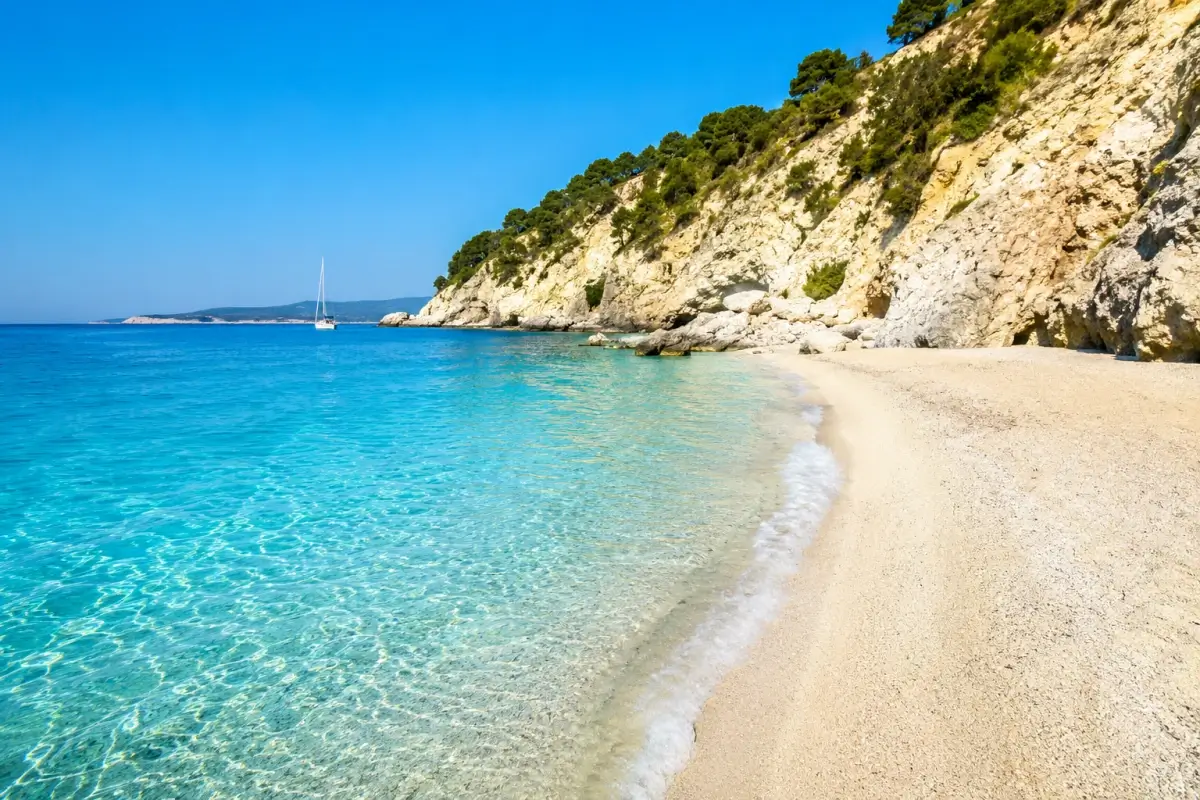
Greece’s most photographed beaches are not always its strongest places to swim, settle in for the day, or reach without friction. The better choice depends on the brief: shallow water and pale-pink sand in Crete, a white-sand base with restaurants in Naxos, an Ionian cliff backdrop, or a compact cove within walking distance of Corfu Town.
This is not a national ranking. These are the beaches we would prioritize for distinct reasons, with their limits kept in view. Summer crowds can materially change the experience at Elafonisi, and some of the best-known Ionian settings require a boat or car. For broader planning, see our Greece guide.
How to choose among Greece’s best beaches
The right Greek beach usually involves a trade among the quality of the swim, the visual setting, the ease of spending a full day there, and the effort required to arrive. A cliff-framed cove can justify its reputation without being the place to base an entire beach holiday. A broad sandy beach with nearby tavernas may be less theatrical, but far more useful.
For calm, shallow water, Elafonisi is the strongest fit in this group. Agios Prokopios makes the better case for an easy white-sand beach holiday with bars and restaurants nearby. Navagio and Myrtos suit a scenery-first itinerary, while Ammos is unusually convenient for travelers arriving by ferry. Faliraki solves a narrower problem well: a quick swim without leaving Corfu Town.
We weigh beach character, swimming suitability, scenery, facilities, access, and the compromises attached to each choice. Read more about how we evaluate destinations.
Elafonisi, Crete: the shallow-water beach day
On Crete’s southwest coast, Elafonisi combines shallow, calm, translucent blue water with shimmering light-pink sand. It is the clearest recommendation here for a day centered on wading, swimming, and time on the shore, not a dramatic viewpoint.
The pink sand distinguishes it visually, but the shallow water makes it more than a photograph. Crete has the scale to support a longer stay, and Elafonisi is one of its defining beach stops. The downside is straightforward: it becomes heavily crowded in summer. Visit in peak season expecting company, not isolation.
Among Crete’s famous beaches, choose Elafonisi when calm water and a gentle beach experience matter more than an imposing cliff setting. Timing will shape the day almost as much as the beach itself. For seasonal context, see the best time to visit Greece.
Access: Confirm current transport arrangements before committing to a beach day at Elafonisi.
Agios Prokopios, Naxos: the strongest all-around beach base
Agios Prokopios is the practical pick for a classic sandy Greek-island beach holiday. Naxos is repeatedly recommended in traveler discussion for its white-sand beaches, particularly along the west coast from Naxos Town toward Alyko. One traveler who stayed at Agios Prokopios described it as a beachfront base they “absolutely loved,” with enough bars, tavernas, and nightlife across the island to support a longer stay.
Its appeal is not the single-image drama of Navagio or Porto Katsiki. It is a broad beach setting with white sand, plus restaurants and bars as part of the surrounding stay. Beach time does not need to become a logistical project every afternoon.
Paros provides a useful comparison. Some travelers strongly favor Naxos for white-sand beaches and consider it the better beach-focused choice, though views on Paros vary. Within Naxos, Agios Prokopios is also close to Plaka, another beach suggested by travelers seeking sand, water, and beach bars.
For a week built around swimming, nearby meals, and an uncomplicated rhythm, we would take Agios Prokopios over a more remote Ionian beach.
Access: Agios Prokopios is documented as a beachfront base on Naxos. Confirm current local transport options when choosing where to stay.
Myrtos, Kefalonia: scenery first, swimming second
Myrtos is Kefalonia’s choice for coastal spectacle. It sits within the Ionian landscape that gives the island its “emerald isle” reputation, particularly in early spring, when green terrain meets the deep blue sea. Among the Ionian beaches in this shortlist, Myrtos earns its place through the composition of island, coast, and water, not documented beach-day conveniences.
A dramatic shoreline does not automatically make the easiest place to swim, eat, or stay for hours. Prioritize Myrtos when the view is the point. Elafonisi has the clearer proposition for a softer, calmer, more explicitly swimming-led day; Agios Prokopios is more useful as a beach base with nearby dining.
Kefalonia also carries Venetian influence in its food and architecture, the result of centuries under Venetian rule. That gives the island more substance than a single beach stop, though Myrtos remains the visual reason to come.
Access: Confirm the current route and beach-day practicalities locally before setting out.
Navagio, Zakynthos: the iconic cove best seen on its terms
Navagio, also called Shipwreck Beach, remains one of Greece’s defining beach images: the rusted remains of the MV Panagiotis in a sandy cove enclosed by cliffs. The vessel washed ashore after a storm in the 1980s and is now inseparable from the beach’s identity.
Its central limitation is just as defining. Navagio is reachable only by boat, so it is not the flexible beach day to choose if the plan depends on arriving independently, changing plans easily, or combining a swim with nearby restaurants. It is an icon first and a straightforward beach base second.
The physical setting still makes it worth prioritizing, particularly for travelers already on Zakynthos. The island also has limestone caves, including the Blue Caves, known for the color of the water. Approach Navagio as a boat-access coastal sight, not a conventional all-day beach.
Boat operations and on-the-day arrangements can change, so confirm current landing and swimming arrangements before booking. For a sea-based Greece itinerary, see the best Greece cruises.
Access: Navagio is reachable only by boat.
Porto Katsiki, Lefkada: Ionian color without an island-hopping detour
Porto Katsiki is Lefkada’s signature beach, defined by craggy cliffs descending toward the blue-green sea. It concentrates the Ionian visual language: pale rock, a sharply drawn coast, and water color that makes Lefkada a serious alternative to a Cycladic island stay.
The practical advantage is island-level, not beach-specific. Lefkada is connected to the mainland by a causeway, and travelers can enter from the mainland over a floating bridge. This removes the ferry dependency that shapes many Greek island trips, though car travel still matters for exploring beyond one town or shoreline.
Porto Katsiki belongs here because the scenery is unusually strong without island hopping. Do not choose it assuming calm water, extensive facilities, or an effortless beach setup. Those are separate questions from the photographic setting and should be checked closer to travel.
A road-trip itinerary can make Lefkada particularly logical. For ideas beyond the beach, see our Greece itinerary guide.
Access: Lefkada is connected to mainland Greece, and a car is relevant for exploring the island. Confirm Porto Katsiki’s current beach-specific approach before departure.
Ammos, Koufonisia: the rare beach at the arrival point
Ammos Beach on Ano Koufonisi begins where many island stays do: by the main village of Chora, immediately after the ferry arrival point. Soft sand, blue-green water, mountains, and fishing boats give it material appeal, while its proximity to the village is rare among the beaches here.
That convenience changes the shape of a short stay. Ammos works for a swim on arrival, a final afternoon before departure, or a low-effort beach day while staying near Chora. There is no need to reserve it for a dedicated expedition.
The trade-off is scale. A traveler discussion describes Koufonisia as highly popular with Greek visitors and notes that its small size can make it crowded during popular periods. Another account describes the island as uncrowded, so the sensible conclusion is seasonal rather than absolute: do not assume a small island will feel empty when demand is high.
Access: Ammos is located by the main village of Chora on Ano Koufonisi, immediately after the ferry arrival point.
Faliraki, Corfu Town: the practical urban swim
Faliraki is not Corfu’s defining beach. It is the sensible answer for travelers staying in Corfu Town who want a swim without making it a separate excursion. This tiny cove sits beneath a high stone wall and is reached by strolling from Old Town.
The beach is small and stony, but the water is described as calm and aqua-colored. Water shoes are a practical addition, not an optional flourish. Faliraki works as a compact swimming break between time in town, particularly when the alternative is giving up a beach stop altogether.
Do not confuse it with Corfu’s broader coastal destinations. Paleokastritsa is a seaside resort between cliffs, small crescent bays, and caves, while Kassiopi is a former fishing village on the northeast coast. Both are fuller coastal outings. Faliraki is the quick, close-in alternative.
For a stay focused on Corfu Town rather than a resort coast, this is the beach we would keep in reserve. Continue with the dedicated Corfu guide for where to stay, what to do, and the island’s broader coastal options.
Access: Faliraki can be reached on foot from Corfu Town.
What we would skip for this brief
Santorini: The caldera, whitewashed towns, and volcanic landscape justify a Santorini trip, but not a beach-led one. A beach-focused account judged its beaches weaker than the island’s scenery and reported severe crowds in August. Choose Santorini for the caldera, not as the primary answer to a beach holiday.
Folegandros: Traveler advice points to small, less compelling beaches around the harbor, while the better options are pebble beaches that require hikes. That can suit walkers, but it does not meet the brief for easy sand, nearby facilities, and a low-effort swim.
Paros: Paros should not be dismissed outright. One traveler praised the island’s southeastern beaches as fantastic and not overcrowded, while another called it more expensive and judged its beaches weaker than Naxos. The conclusion is narrower: for this brief, Naxos has the clearer case for white sand and an easy beach base.
Greece’s clearest water depends on the beach and conditions
There is no single definitive winner. Elafonisi is the strongest choice in this shortlist for shallow, calm, translucent blue water, while Ammos is known for blue-green water beside Ano Koufonisi’s main village. Porto Katsiki is associated with Lefkada’s blue-green sea and cliff-backed coast. Navagio is visually exceptional for its sandy cove and enclosing cliffs, but boat-only access makes it less flexible.
Water clarity can shift with weather, season, and the exact part of a beach visited. Choose Elafonisi for the most clearly documented swimming-led water experience, and Porto Katsiki or Navagio when coastal scenery is the stronger priority.